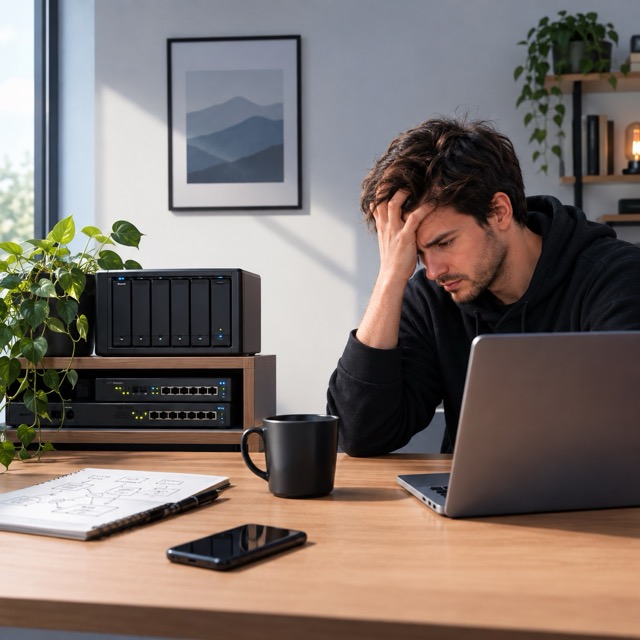
I added a second server to make my homelab simpler.
That sounds backwards. More hardware means more cables, more power adapters, more things to update, more to look at. The minimalist move would be to run everything on one machine.
But after years of working with technology, I've found that fewer things don't always add up to a simpler system. Sometimes having less creates more friction. And sometimes adding the right piece of technology makes everything feel less cluttered.
Here's how I think about that trade-off.
Clutter and friction aren't the same thing
I'm a minimalist who also loves technology, so I'm always trying to balance two things that pull in opposite directions.
Clutter is anything that consumes space, attention, or maintenance without giving enough back. That's physical — unused computers, cables, adapters, old hard drives — and it's digital — abandoned VMs, duplicate apps, forgotten Docker containers, dashboards you never open.
Friction is anything that makes a useful action harder than it needs to be. Shutting down every service in the house to update one server. Spending twenty minutes looking for a cable. Opening five dashboards to work out why something stopped.
The tricky part is that reducing one often increases the other. Consolidate everything onto one box and you cut physical clutter, but you can build a system that's harder to maintain. Keep adding apps to fix small annoyances and eventually the apps are the annoyance.
Zero clutter and zero friction are both unrealistic. The goal I actually aim for: only add something when it removes more friction than it creates.
Why I run two servers and two NAS devices
My homelab is four devices — two servers and two NAS units — in a 600-square-foot apartment. For a channel called UnclutteredTech, that probably sounds like a lot. (I've written before about running two servers instead of one and keeping Proxmox and my NAS separate.)
That split creates more physical clutter, but it gives each device one clear job. I can test VMs and containers without putting my storage at risk. I can restart one server without taking everything else down. When something breaks, it's easier to find.
Could I combine more of it? Sure. But consolidation creates dependencies between things I'd rather keep independent. I'd save a little space and pay for it on every update, every experiment, every hardware failure — because the blast radius would be bigger. That risk is friction.
More hardware, in this case, gives me a simpler mental model. I know what each box does, I know what breaks when I touch it, and I'm not afraid to touch it. That's worth an extra device to me.
Two applications can be simpler than one
Same idea on the software side.
I use Uptime Kuma to monitor my sites, apps, and devices. It answers one question: is this thing running? I also use Beszel for deeper server monitoring — resource usage, Docker stats, history — when I need to understand why something is struggling.
Two monitoring tools looks like digital clutter. Why not run one platform that does everything? I could. I'd spend a weekend configuring it and building dashboards, and at the end I'd have added complexity so I could say I run one app instead of two.
Uptime Kuma tells me whether something is up. Beszel helps me dig into what's happening inside. Different jobs, and each tool makes its job easy.
That's the line I try to hold: duplication is clutter, specialization can reduce friction. If two tools keep showing me the same information, I probably don't need both. If they solve different problems and make each one easier to understand, keeping both is the simpler choice.
The self-hosting clutter trap
This can obviously go too far.
One of the best parts of running a homelab is discovering self-hosted software. Browse GitHub, the self-hosting communities, or the Proxmox helper scripts and you'll find something for almost anything — free, well built, running in minutes. That makes experimenting fun. It also makes hoarding digital clutter effortless.
You spin up a container because it looks interesting. You try it for an afternoon, figure you might use it later, and leave it running. Next week you do it again. Eventually you've got a homelab full of services that all need updates, backups, storage, and attention — and only a handful are actually making your life easier.
Free software still has a cost. It doesn't show up on a statement; you pay in time, system resources, and mental overhead. Every service is one more thing that can break, one more thing to migrate, one more thing you'll have to relearn in six months.
So I declutter on a schedule. About once a week I do a quick pass for experiments I'm done with or services I know I won't use. Every month or quarter I do a deeper review and ask four questions:
Do I actually use this?
Does it do a job nothing else does?
Would I notice if I turned it off?
If it died tomorrow, would I bother restoring it?
If I can't answer those convincingly, the service isn't reducing friction anymore. It's clutter.
Physical clutter still matters
Even when a device earns its place, I don't want to look at it all day. I live in a modest one-bedroom apartment. I like technology, but I want my home to feel like a home, not a server room.
Most of my homelab lives inside a wooden cabinet — USB fans added, ventilation cut into the back, a gap left between the cabinet and the wall for airflow. Closed, the technology mostly disappears. Cables, adapters, and filming gear live in one central closet on shelves, in clear bins, with some Gridfinity storage. When I film, I open the doors and everything's right there. When I'm done, I close them and the apartment feels calm again.
I haven't gotten rid of the equipment. I've given it a boundary. That cuts visual clutter, because I'm not staring at it while I relax, and it cuts friction, because I always know where things are. Often the problem isn't owning too much — it's that what you own has no clear home.
My rule for adding technology
Before anything new goes into the homelab, I try to answer four questions.
What specific problem does this solve? If I can't describe the problem, I'm adding it because it's interesting, not useful. Fine for a temporary experiment; not automatically permanent.
How often do I hit this friction? I'm not buying hardware or running another service to avoid a five-minute annoyance that happens once a year.
What maintenance does it create? Something that saves ten minutes a month but costs an hour of updates and troubleshooting isn't simplifying anything.
Does it make the system easier to understand and recover? The simplest system isn't the one with the fewest parts. It's the one I can understand, maintain, and restore when it breaks.
If an addition passes, I don't count it as clutter — even if it's another box or another app. It's infrastructure with a purpose.
The real minimalist homelab
For me, minimalism isn't owning the fewest possible things. It's being intentional about what I keep.
A one-server homelab can be cluttered if it's full of services you don't understand or use. A four-device homelab can feel simple if every device has a clear role and the whole thing is easy to maintain. The goal isn't the fewest servers, containers, or cables. It's the fewest things you need to remember, fear, or babysit.
Sometimes that means removing technology. Sometimes it means separating responsibilities or adding a dedicated tool. Every addition creates some clutter; it should only stay if it removes more friction than it introduces. That balance is different for everyone, and it shifts as your needs change. A homelab is a journey, and experimenting is part of the fun — you just don't have to keep every experiment.
If you want the checklists and the four-question filter in one place, I put them in a short free PDF — The Homelab Minimalism Toolkit.
What's one part of your homelab where adding something actually made it simpler? Or have you consolidated a setup and found it created more friction than it removed? Let me know in the comments — and if you'd rather watch this one, the video is on UnclutteredTech.